What Is an AC Condenser and Which Type Is Best?
An air conditioner can feel mysterious until you follow the heat. The indoor coil absorbs warmth, while the outdoor condenser releases it into the surrounding air. Ac Condensers perform this critical outdoor task through a coil, fan, and refrigerant circuit. When the system runs, you may feel warm air blowing from the outdoor unit. That is normal. It means heat is leaving your home.
HVACR educator Eugene Silberstein describes a condenser as “a heat exchanger that rejects heat from the refrigerant to another medium.” This simple explanation matters when comparing condenser designs. Air-cooled models are common in homes because they use outdoor air and require no water supply. Water-cooled models can operate efficiently in suitable commercial settings, but they need pumps, controls, and regular maintenance. Evaporative condensers may reduce condensing temperatures, though their water use and climate limits deserve attention.
The best type depends on more than efficiency labels. Climate, noise, available space, coil protection, repair access, and installation quality all influence real performance. A dusty coil can waste energy. A shaded, unobstructed unit usually breathes better. Still, shade is not a cure for poor airflow.
There is no universal winner. That answer feels unsatisfying. Yet it is more honest.
This guide examines how each condenser type works, where it performs well, and what can go wrong. It also considers practical ownership details, including cleaning, corrosion, refrigerant pressures, and replacement decisions. Manufacturer specifications and local HVAC expertise should guide the final choice, especially when a system operates in extreme heat, coastal air, or a tightly confined installation area.
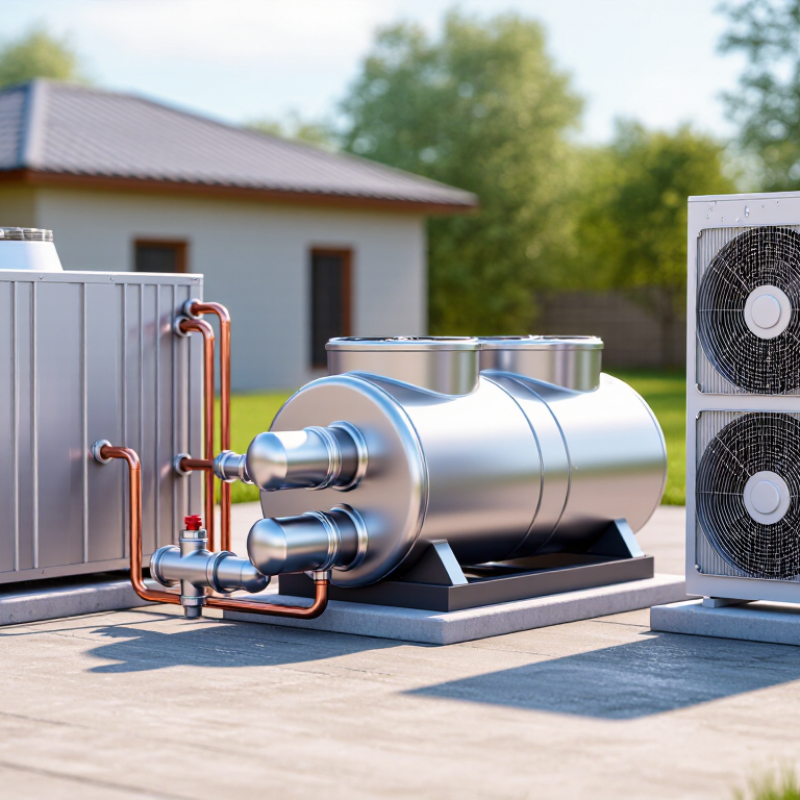
AC Condenser Basics: How Refrigerant Rejects Heat at 30–55°C
What Is an AC Condenser and Which Type Is Best?
AC Condenser Basics: How Refrigerant Rejects Heat at 30–55°C
An AC condenser is the outdoor heat exchanger in a refrigeration cycle. It receives hot, high-pressure refrigerant vapor from the compressor. At roughly 30–55°C, the refrigerant must release heat into outdoor air. As heat leaves, the vapor changes into a high-pressure liquid.
The process depends on temperature difference, airflow, and coil condition. Aluminum fins spread heat across a wide surface. A fan pulls ambient air through the coil. Refrigerant moves inside copper or aluminum tubes. On a 35°C day, condensing temperature may rise well above outdoor temperature. Dirty fins, blocked airflow, or a weak fan can increase pressure. The compressor then works harder and consumes more electricity. I have seen dust cause noticeable performance changes, although results vary with humidity and system design.
Air-cooled condensers suit most homes because they are simple and water-free. Water-cooled units can reject heat efficiently in larger installations. However, they require pumps, water treatment, and regular maintenance. Evaporative condensers may help in dry climates, but water quality becomes important. The best type is not universal. A technician should match capacity, refrigerant requirements, climate, noise limits, and service space. Manufacturer data and measured operating pressures matter more than appearance. This guidance has limits. A condenser cannot correct an undersized compressor or poor system design.
Air-Cooled vs Water-Cooled Condensers: COP, Capacity, and Water Use
What Is an AC Condenser and Which Type Is Best?
An AC condenser rejects indoor heat outdoors and turns high-pressure refrigerant vapor into liquid. The choice between air-cooled and water-cooled designs affects COP, capacity, maintenance, and water demand.
Air-cooled condensers use fans and ambient air. They need less infrastructure and avoid water treatment. However, capacity and COP decline when outdoor temperatures rise. Dusty coils can worsen that drop. Water-cooled condensers use a cooling tower or similar heat-rejection system. They usually maintain lower condensing temperatures, improving compressor efficiency and available capacity. DOE Federal Energy Management Program guidance commonly places water-cooled chiller COP near 5–7, compared with roughly 3–4 for many air-cooled systems. Actual results depend on load, entering water temperature, and condenser cleanliness.
Water has a cost.
The U.S. Department of Energy’s cooling-tower guidance estimates about 1.8 gallons of evaporative water use per ton-hour at a 10°F range, before considering blowdown and drift. Water-cooled equipment can therefore deliver better part-load performance in large facilities, but its water footprint deserves measurement. ASHRAE Handbook—Refrigeration also emphasizes regular tube cleaning, water treatment, and approach-temperature checks. A neglected tower can erase its efficiency advantage. In practice, the best selection is not always the highest-COP option. A dry, water-scarce site may reasonably choose air cooling, even with higher electrical demand. That trade-off is easy to underestimate.
| Performance or Design Dimension | Air-Cooled Condenser | Water-Cooled Condenser | Best Fit |
|---|---|---|---|
| How It Rejects Heat | Releases refrigerant heat directly to outdoor air through finned coils and fans. | Transfers refrigerant heat to condenser water, which usually rejects the heat through a cooling tower or dry cooler. | Depends on site conditions |
| Typical System Capacity | Commonly used from small packaged systems up to approximately 500 refrigeration tons (1,760 kW of cooling), with larger applications possible. | Commonly selected for medium and large chilled-water plants, often from approximately 20 to more than 1,000 refrigeration tons (70 to 3,517 kW). | Water-cooled for large plants |
| Typical Full-Load COP | Approximately 2.5–3.5 for many conventional air-cooled chillers under standard rating conditions. | Approximately 4.0–6.0 for many conventional water-cooled chillers under standard rating conditions. | Water-cooled |
| Part-Load Efficiency | Can be efficient at moderate loads with variable-speed fans, but performance is strongly affected by outdoor temperature. | Often provides strong part-load efficiency because entering condenser-water temperature can be lower than outdoor air temperature. | Usually water-cooled |
| Effect of Outdoor Temperature | High outdoor temperatures raise condensing pressure and can reduce capacity and COP. Output may drop during heat waves. | Less directly affected by outdoor dry-bulb temperature, but performance depends on outdoor wet-bulb temperature and cooling-tower approach. | Water-cooled in hot climates |
| Water Consumption | No continuous condenser-water consumption. Small amounts may be needed for coil cleaning or maintenance. | Cooling-tower systems typically consume water through evaporation and blowdown. A practical planning range is approximately 0.5–2.0 gallons per ton-hour (0.06–0.25 L/kWh of cooling), depending on climate, cycles of concentration, and tower operation. | Air-cooled where water is scarce |
| Installation Requirements | Requires outdoor clearance, adequate airflow, structural support, electrical service, and access for coil cleaning. | Requires condenser-water pumps, piping, water treatment, a cooling tower or heat-rejection device, and additional mechanical-room space. | Air-cooled for simpler projects |
| Initial Cost | Generally lower because there is no cooling tower, condenser-water loop, water treatment system, or condenser-water pump. | Generally higher because of the tower, pumps, piping, controls, water treatment, and additional installation work. | Air-cooled |
| Operating Cost | Usually has lower water and maintenance costs, but electrical consumption may be higher at high ambient temperatures. | Often has lower compressor energy use at larger scale, but adds pumping, fan, water, treatment, and maintenance costs. | Water-cooled for high annual runtime |
| Maintenance Needs | Clean coils, inspect fans and motors, check refrigerant circuits, and maintain adequate airflow. | Maintain tubes, pumps, tower fill, drift eliminators, water chemistry, filtration, and biological-control programs. | Air-cooled for lower maintenance complexity |
| Noise and Visual Impact | Fans can produce noticeable outdoor noise, and large coil banks may require significant roof or yard space. | Cooling-tower fans and pumps create noise, but the chiller itself can be located indoors; tower placement remains important. | Project-specific |
| Water Quality Risk | No condenser-water scaling, corrosion, or biological-growth risk. | Requires treatment and monitoring to control scale, corrosion, fouling, and microbial growth, including Legionella-related risks. | Air-cooled |
| Expected Service Life | Often approximately 15–20 years when properly maintained, depending on corrosion, operating hours, and component quality. | Chiller equipment can often operate for approximately 20–25 years, but towers, tubes, pumps, and water-treatment components may require earlier refurbishment or replacement. | Water-cooled for long-term plants |
| Carbon and Resource Trade-Off | Avoids operational water use but may require more electricity, especially during hot weather. | Can reduce electricity consumption but uses water and treatment chemicals, creating a site-specific environmental trade-off. | Depends on local utility mix and water availability |
| Recommended Application | Small to medium buildings, water-stressed locations, projects with limited maintenance staff, and installations where simple construction is a priority. | Large commercial or industrial facilities with high cooling loads, long operating hours, reliable water supplies, and access to qualified maintenance personnel. | Choose by lifecycle cost |
| Technical note: COP values are representative ranges for complete chiller systems at typical rating conditions, not for the condenser component alone. Actual results vary with refrigerant, compressor type, entering condenser temperature, outdoor wet-bulb or dry-bulb temperature, fouling, control strategy, and part-load operation. One refrigeration ton equals 12,000 Btu/h, or approximately 3.517 kW of cooling. | |||
Fin-and-Tube vs Microchannel Coils: Heat-Transfer Design Data
An AC condenser rejects indoor heat outdoors, and its coil design strongly affects capacity, efficiency, serviceability, and refrigerant charge. Fin-and-tube coils use round copper tubes expanded into aluminum fins. Microchannel coils use flat multiport tubes with louvered fins and smaller internal passages.
In comparable tests, microchannel coils often provide 10–25% higher heat-transfer performance per face area. Their compact passages can reduce refrigerant charge by roughly 30–50%. They may also achieve lower airside pressure drops, commonly around 50–150 Pa, depending on fin density and airflow. Fin-and-tube designs remain practical for dusty locations. Their wider passages tolerate moderate fouling and allow more repair options. A typical design may use 8–12 mm tubes, two to four rows, and face velocities near 2–3 m/s.
Field measurements matter more than catalog claims. At 35°C outdoor air, a blocked coil can raise condensing temperature quickly. Microchannel fins can collect debris tightly, making cleaning technique critical. High-pressure washing may bend fins or drive dirt deeper. I would not call one design universally best. Microchannel usually suits compact, charge-sensitive equipment, while fin-and-tube can offer easier maintenance and stronger repair flexibility. Results change with humidity, airflow, fin spacing, and refrigerant selection. Some published comparisons also overlook coating condition and seasonal fouling. That weakens confidence. A reliable choice requires measured airflow, pressure drop, entering-air temperature, and condensing temperature under the actual operating load.
Condenser Sizing Explained: 1 Ton Equals 12,000 Btu/h
What Is an AC Condenser and Which Type Is Best?
Condenser Sizing Explained: 1 Ton Equals 12,000 Btu/h
An AC condenser releases indoor heat outside through the outdoor coil. It usually includes a compressor, fan, coil, and electrical controls. Air-cooled condensers are common in homes because they use outdoor air and need less plumbing. Water-cooled designs can perform efficiently, but they require a reliable water supply and more maintenance.
Sizing begins with cooling capacity. One ton equals 12,000 Btu/h. A two-ton system provides about 24,000 Btu/h, while a three-ton system provides about 36,000 Btu/h. This conversion is useful. It is not a complete sizing method.
A proper calculation considers floor area, insulation, window direction, ceiling height, occupancy, duct leakage, and local weather. A sunny room with old windows may need more capacity than its size suggests. I have seen oversized equipment short-cycle on mild days, leaving rooms cool but damp. That is an important warning.
Bigger is not always better.
An undersized condenser may run constantly during peak heat. An oversized unit may start and stop too often, reducing comfort and compressor life. The indoor coil, airflow, refrigerant, and outdoor condenser must also match. Airflow problems can make a correctly sized system perform badly. Professional load calculations and manufacturer data provide safer answers than floor-area guesses. Even experienced technicians should verify existing conditions before recommending a replacement.
Choosing the Best Type: Climate, SEER2, Maintenance, and Service Life
What Is an AC Condenser and Which Type Is Best?
An air conditioner condenser sits outdoors and releases indoor heat into the air. Its coil, fan, compressor, and controls work together under pressure. Air-cooled condensers suit most homes because installation is simpler and water use is minimal. In dry climates, they usually perform reliably. Very humid or dusty conditions demand closer attention. Dust acts like a blanket. The system works harder.
Climate should guide the choice more than attractive specifications. In hot regions, select equipment with strong capacity at high outdoor temperatures. A higher SEER2 rating can reduce seasonal electricity use, but it does not guarantee lower bills. Poor ductwork, incorrect refrigerant charge, or short cycling can waste those expected savings. SEER2 evaluates the matched system, not the condenser alone. Ask a qualified technician to verify compatibility and airflow before purchase.
Maintenance also affects service life. Keep leaves away from the cabinet, wash the outdoor coil carefully, and check electrical connections during annual service. Do not bend delicate fins. A condenser that runs constantly, vibrates, or blows unusually warm air needs professional testing. Many units last roughly 10 to 15 years, though coastal salt, severe heat, and neglected filters can shorten that period. More expensive is not always better. Sometimes, the overlooked installation detail matters most.
What Is an AC Condenser and Which Type Is Best?
Typical service life varies by condenser design, climate, water quality, installation quality, and maintenance. Air-cooled condensers are common for homes, while water-cooled and evaporative designs are more common in larger systems.
| Condenser type | Climate suitability | Efficiency metric | Typical maintenance |
|---|---|---|---|
| Air-cooled | Most climates; performance can decline during very high outdoor temperatures | Residential systems are commonly rated by SEER2 | Coil cleaning, airflow checks, and electrical inspection at least annually |
| Water-cooled | Useful where reliable water treatment and cooling-tower service are available | Usually evaluated with EER, IPLV, or IEER rather than residential SEER2 | Water treatment, tube cleaning, scale control, and tower maintenance |
| Evaporative | Best in dry climates with low humidity and suitable water quality | Efficiency depends strongly on entering-air temperature and humidity | Frequent water-system cleaning, pad or media inspection, and mineral-scale control |
The chart shows broad industry-typical service-life ranges, not guarantees. A properly sized, correctly installed, and regularly maintained condenser generally lasts longer than one exposed to corrosive air, dirt, blocked airflow, poor water quality, or neglected repairs.