7 Best Grey Retail Shelving Options for Global Buyers
Choosing Grey Retail Shelving involves more than matching fixtures to a store’s color palette. Global buyers must consider product weight, floor space, installation needs, and the realities of shipping. A finish that looks subtle in a catalog may appear warmer or cooler under a shop’s lighting. Details matter.
This guide introduces seven common options, including gondola units, wall-mounted shelves, slatwall systems, gridwall displays, wire shelving, mobile racks, and mixed-material designs. Each serves a different purpose. Gondola shelving can organize central aisles, while wall-mounted units help use vertical space. Wire shelves offer visibility and airflow; solid shelves can present boxed goods more neatly. Looks can mislead. Check load ratings and assembly instructions before comparing price alone.
For cross-border purchasing, confirm dimensions, packaging, replacement-part availability, and whether local teams can assemble the system with ordinary tools. Ask suppliers for finish samples when color consistency matters, and request clear specifications rather than relying on product photographs. A gray powder-coated frame may resist everyday wear, but performance depends on materials, coating quality, and care. No option is perfect. Even a sturdy unit can be inconvenient if its shelf spacing does not fit the products you actually sell. The following choices offer a practical starting point, not a universal answer; store layout and merchandise should guide the final decision.
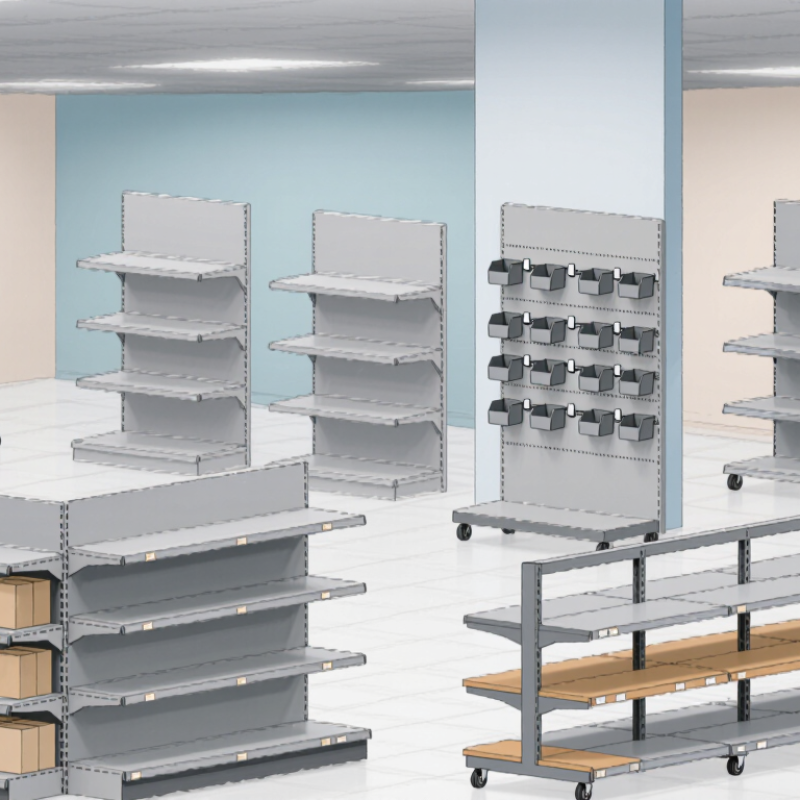
What Grey Retail Shelving Is and Where It Is Used
Grey retail shelving describes store fixtures finished in a grey tone, rather than one specific shelving system. The structure may use steel uprights, adjustable shelves, or wood-effect panels. The finish can be light grey, charcoal, or textured mid-grey. It gives products a calm backdrop and pairs easily with bright packaging, price labels, and wood or white fixtures.
Small detail: grey is not a performance rating. Shelf capacity depends on construction, span, and installation, so buyers should check documented load limits before planning a layout.
Retailers use grey shelving in grocery aisles, pharmacies, convenience stores, electronics departments, and home-goods shops. It can create a consistent look across wall bays and gondola runs, while keeping attention on the merchandise. In a narrow aisle, lighter grey may feel less visually heavy; darker finishes can frame displays but may reveal dust or scratches under strong lighting.
Check the details. A common planning miss is choosing a finish from a sample chip alone. View it beside the actual flooring and lighting, then confirm dimensions, shelf adjustability, edge quality, and cleaning needs. Grey is no cure-all.
Core Materials, Finishes, and Structural Features
Grey retail shelving usually starts with cold-formed steel: it handles everyday stock, resists knocks, and suits adjustable bays. The World Steel Association’s World Steel in Figures 2024 reports 1,892.2 million tonnes of crude steel production in 2023. That scale signals a mature supply base, not a guaranteed shelf rating. Check the supplier’s stated load per shelf and per unit.
Powder-coated grey gives a smooth, wipeable surface and hides minor scuffs better than bright finishes. But chips at corners can expose bare steel. For humid back rooms, compare galvanized components or a corrosion-resistant coating, and inspect cut edges, welds, and fastener holes. Colour samples matter. “Grey” can shift from warm charcoal to cool silver under retail lighting.
Structure matters as much as finish. Look for formed shelf lips, bracing across the back, secure beam connections, and feet that sit flat on uneven floors. ANSI/RMI MH16.1 provides design criteria for industrial steel storage racks; retail fixtures still need load information suited to their specific configuration. A deep shelf may hold more cartons, yet it can obstruct sightlines and invite overloading. I would test a loaded bay in the actual aisle before ordering a full run.
Seven Grey Retail Shelving Types for Different Store Settings
Grey gondola shelving works well in supermarkets and general stores. Its adjustable shelves hold packaged goods, while perforated backs accept hooks for small items. Grey keeps the fixture visually quiet, but it can feel flat under cool lighting. Check samples beside your actual floor and wall colors.
Wall-mounted bays preserve floor space in narrow boutiques. End-cap shelves give promotions a visible position at aisle ends. Wire shelving suits convenience stores and stockrooms where airflow and quick cleaning matter. For premium goods, lockable glass-front units add protection without hiding merchandise. Mobile shelves help pop-up shops change layouts, though loaded units need reliable brakes. Heavy-duty steel racks serve bulk retail and back-of-house storage; they may look too industrial near delicate displays.
Store format matters. The U.S. Census Bureau reported that e-commerce accounted for 16.1% of U.S. retail sales in 2024’s fourth quarter, seasonally adjusted. Physical shelves can support pickup and browsing, but avoid blocking collection routes. Security also deserves attention: the National Retail Federation’s 2023 National Retail Security Survey reported average retail shrink of 1.6% of sales for fiscal 2022. That figure does not mean every store needs locked shelving. Consider sightlines, product value, and staff routines before choosing.
Comparing Capacity, Flexibility, Cost, and Durability
Grey retail shelving should be compared by more than appearance. A wall bay saves floor space, while gondolas offer access from both sides. Boltless and modular units are easier to reconfigure; wire shelves improve visibility and airflow. For heavier stock, check the rated load per shelf and per bay. A rating is useful only when weight is spread evenly and the floor is suitable. Small details matter.
Flexibility has growing value. The U.S. Census Bureau reported that 2024 U.S. e-commerce sales reached about $1.19 trillion, or 16.1% of retail sales. That figure does not describe every market, but it points to changing stock flows and fulfillment needs. MHI’s 2024 Annual Industry Report found that 55% of surveyed supply-chain leaders planned to increase technology and innovation investment that year. Shelving is not automation, yet adjustable shelf heights and compatible accessories can make layout changes less disruptive.
Compare total cost, not just the initial quote. Include freight, installation, replacement parts, and the labor needed to move loaded sections. Powder-coated steel can resist everyday scuffs, but finish quality and damp conditions affect service life. Here is the catch: published load ratings are not always directly comparable. Ask suppliers for test conditions, inspection guidance, and written limits. A neat grey finish helps. It does not prove durability.
How Global Buyers Can Specify, Source, and Maintain Shelving
Specify grey retail shelving by function, not appearance alone. Record the bay width, shelf depth, total height, and expected load for each level. Ask suppliers to state whether load limits apply per shelf or per complete unit. Grey finishes can look different under warm store lighting, so review a physical sample beside your floor and wall materials. Small details matter.
When sourcing internationally, compare drawings, material specifications, finish descriptions, and packaging requirements. Confirm that parts are labeled clearly and that assembly instructions use measurements your local teams can follow. Request photos of packed units and check how corners, uprights, and shelf edges are protected. A sample is useful, but one sample cannot reveal every production variation. I have seen careful plans miss the realities of unloading space and local handling; allow room for those assumptions to change.
Set maintenance expectations before installation. Staff can check loose connections, bent shelves, chipped coating, and uneven feet during routine store walks. Clean with a soft cloth and a mild cleaner approved for the finish; abrasive pads may leave visible marks. Keep a record of inspections and replacement components, especially for high-traffic aisles. It can disappoint. Even well-specified shelving needs adjustment when product weights or layouts change.
| Shelving option | Typical dimensions (W × D × H) | Indicative load per shelf | Common construction and grey finish | Best suited to | Specification and sourcing checks | Maintenance guidance |
|---|---|---|---|---|---|---|
| 1. Steel gondola shelving | Single-sided bays: 600–1,200 × 300–600 × 1,200–2,400 mm Double-sided bays: 600–1,200 × 600–1,200 × 1,200–2,400 mm | Typically 50–100 kg, evenly distributed | Formed steel uprights, base decks, and adjustable shelves; commonly powder-coated in light or dark grey. | General merchandise, grocery, pharmacy, and other open retail sales floors. | Confirm bay length, shelf depth, upright pitch, base configuration, end panels, and compatibility with accessories. Request the rated load for the exact shelf size. | Check uprights and base connections periodically. Replace bent or damaged parts and avoid point-loading shelves. |
| 2. Boltless steel shelving | 900–1,500 × 300–600 × 1,800–2,400 mm | Typically 100–300 kg, evenly distributed | Steel frames with clip-in or rivet-style beams; grey-painted or grey powder-coated finish. | Backroom stock, reserve inventory, and light-to-medium retail storage. | Check assembly method, shelf material, beam engagement, corrosion protection, and whether the stated rating applies to each shelf or the complete bay. | Keep beams fully seated and the unit level. Inspect clips, braces, and shelves after relocation or impact. |
| 3. Slotted-angle steel shelving | 600–1,200 × 300–600 × 1,200–2,400 mm | Typically 50–150 kg, evenly distributed | Perforated steel angles bolted to shelves or panels; grey-painted components are widely used. | Small stockrooms, utility areas, and adjustable storage layouts. | Confirm hole spacing, bolt size, shelf panel material, and the availability of replacement fittings in the destination market. | Retighten fasteners after initial loading and routine use. Check for corrosion, loose bolts, and sharp damaged edges. |
| 4. Wire shelving | 600–1,200 × 350–600 × 1,200–1,800 mm | Typically 100–250 kg, evenly distributed | Welded steel wire shelves with posts; grey epoxy-coated or other corrosion-resistant grey finishes are available. | Produce areas, stockrooms, and locations where visibility and airflow are useful. | Specify coating suitability for the environment, shelf dimensions, post height, leveling feet, and any required food-contact compliance for the intended application. | Clean with a suitable non-abrasive cleaner. Inspect coating for chips and check that shelf collars and leveling feet remain secure. |
| 5. Wall-mounted steel shelving | 600–1,200 × 200–400 mm shelf depth; height depends on wall layout | Typically 20–60 kg per shelf, subject to wall and fixing capacity | Grey steel brackets or standards with adjustable steel shelves; fixed directly to a suitable wall structure. | Compact shops, perimeter displays, and areas where floor space is limited. | Verify wall substrate, anchor type, fixing spacing, and combined shelf-and-wall load limits. Do not assume a shelf rating applies regardless of wall construction. | Inspect anchors and brackets regularly, especially after store alterations. Remove the load before adjusting shelves. |
| 6. Mobile shelving | Modules commonly 900–1,200 mm wide × 300–600 mm deep; height often 1,800–2,400 mm | Typically 50–150 kg per shelf, depending on the system | Steel shelving mounted on lockable or track-guided mobile bases; grey finishes are common. | High-density storage for backrooms, archives, and limited-floor-area retail operations. | Specify floor condition, base type, aisle access, anti-tip features, braking or locking method, and total system load. Confirm installation and service requirements. | Keep tracks clear and inspect wheels, brakes, and anti-tip components. Follow the system maker’s operating and maintenance instructions. |
| 7. Retail backroom pallet racking | Frames commonly 900–1,100 mm deep and 2,000–6,000 mm high; bay width is selected for the pallet size | Beam-pair capacity often ranges from about 1,000–3,000 kg; this is not a per-shelf rating | Structural or roll-formed steel frames and beams; grey-painted finishes may be specified. | Bulk reserve stock and palletized inventory in larger retail backrooms or distribution areas. | Design for pallet dimensions, load weight, handling equipment, clearances, floor capacity, and local safety requirements. Obtain a system-specific load schedule and installation plan. | Keep load notices visible and inspect frames, beams, connectors, and floor anchors for damage. Restrict access to damaged sections pending assessment. |
| Important specification note: Dimensions and load figures above are indicative planning ranges, not universal product ratings. Actual capacity depends on shelf size, materials, span, support configuration, installation, and loading method. Confirm certified or manufacturer-published ratings for the exact system, and check applicable local building, fire, seismic, and workplace-safety requirements before purchase or installation. | ||||||