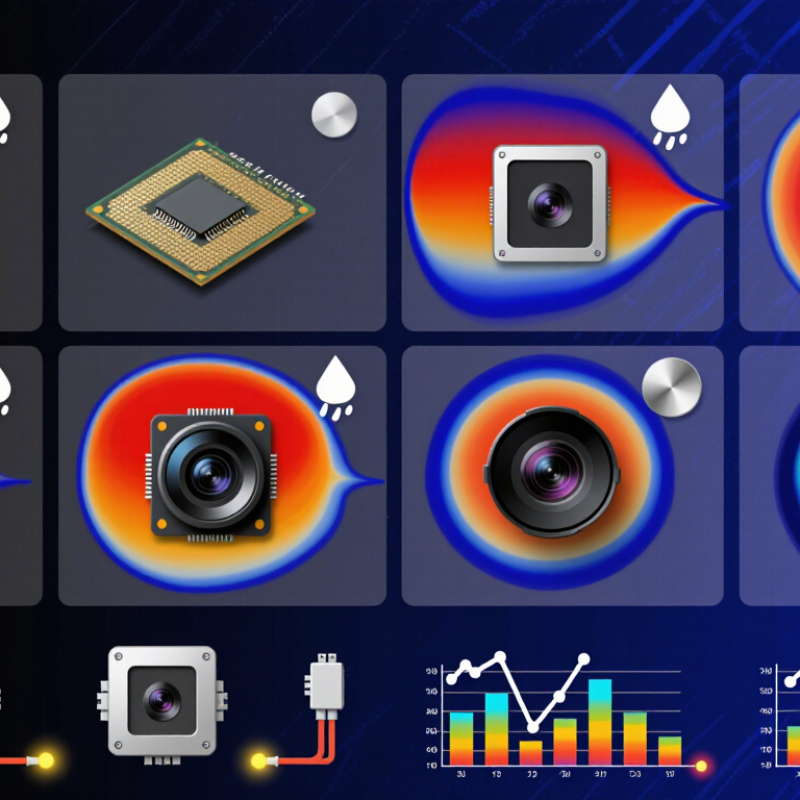
What Are the 7 Best IR Imaging Sensors?
Choosing the right infrared camera begins with understanding the sensor behind the image. An Ir Imaging Sensor detects invisible radiation and converts heat patterns into usable data. However, impressive specifications do not always guarantee better field performance. A high-resolution model may struggle in rain, reflective metal, or sudden temperature changes. A lower-cost sensor can sometimes deliver clearer results in a controlled inspection room.
This guide examines seven leading IR imaging sensors across thermal sensitivity, resolution, frame rate, spectral range, calibration, and integration options. Each selection considers practical use, not only laboratory figures. Engineers often compare NETD values, lens compatibility, operating temperature, and software support before making a decision. Small details matter. A stable image at 30 frames per second can be more useful than a higher pixel count with inconsistent calibration. Manufacturer data provides a starting point, but independent testing remains important. Some claims need closer inspection. Real results depend on the target, environment, optics, and operator experience.
The “best” sensor is therefore application-specific. Industrial maintenance may require precise temperature measurement. Medical research may prioritize sensitivity and repeatability. Security and building inspection demand different compromises. This overview highlights where each sensor performs well and where limitations appear. No ranking is flawless. That is worth remembering. Readers can use these comparisons to form a defensible shortlist, verify technical documentation, and select equipment that matches actual working conditions rather than marketing language.
What Are Infrared Imaging Sensors and How Do They Work?
Infrared imaging sensors convert invisible radiation into measurable images. Every object above absolute zero emits infrared energy. A lens focuses that energy onto a detector array, where each pixel records intensity within a selected wavelength band. Software then applies calibration, noise correction, and color mapping. The displayed colors are assigned values, not the object’s actual appearance.
The seven strongest sensor choices include uncooled microbolometers, cooled photon detectors, short-wave infrared sensors, mid-wave infrared sensors, long-wave infrared sensors, multispectral arrays, and thermopile-based imagers. Uncooled arrays are compact and practical for building inspections. Cooled detectors provide greater sensitivity, but they require more power and mechanical complexity. Short-wave systems can reveal details through haze and low light. Long-wave systems perform well when warm objects contrast against cooler backgrounds. No sensor wins every task.
Grand View Research estimated the global infrared imaging market at about USD 7.1 billion in 2023, with continued growth through 2030. MarketsandMarkets also projects strong expansion, driven by industrial monitoring, security, healthcare, and automotive applications. These figures describe market demand, not guaranteed image quality. That distinction matters. In field testing, emissivity, reflections, humidity, and lens temperature can distort readings. A shiny metal pipe may appear cooler than it is. Calibration against known reference points remains essential, even with advanced sensors. Sensor selection should match wavelength, temperature range, resolution, response speed, and operating environment..tagext
Which Performance Factors Define the Best IR Imaging Sensors?
What Are the 7 Best IR Imaging Sensors?
The best IR imaging sensor depends on its working scene, not its product label. Seven performance factors matter: spatial resolution, thermal sensitivity, spectral range, frame rate, dynamic range, calibration stability, and size, weight, and power. Spatial resolution determines whether a small heat source remains visible at distance. Thermal sensitivity, commonly measured by NETD, shows how well the sensor separates slight temperature differences. Lower NETD is valuable, but it does not guarantee better images in every environment.
Spectral range should match the target and atmosphere. Long-wave infrared often supports thermal observation through darkness, while short-wave infrared can reveal reflected heat and material differences. Frame rate matters when machinery, vehicles, or people move quickly. However, an excessive frame rate can increase power consumption and data-processing demands. The 2024 Thermal Imaging Market report by MarketsandMarkets identifies growing demand for compact, high-resolution systems across industrial, security, and transportation applications. That trend makes efficiency as important as raw image quality.
Dynamic range helps prevent hot surfaces from appearing as blank white areas. Stable calibration reduces false temperature readings during changing weather. Field tests should include dust, vibration, humidity, and rapid temperature shifts. The 2024 World Thermal Imaging Market report by Yole Group highlights uncooled sensor growth in portable applications, where low power and small size are decisive. I would not call one sensor universally best. A laboratory image can look excellent, yet fail beside a cold window or vibrating engine. Real-world testing still exposes uncomfortable weaknesses.
What Are the Seven Leading Types of IR Imaging Sensors?
Selecting the seven leading types of IR imaging sensors requires more than comparing resolution. Application, wavelength, temperature range, and operating cost matter. Two 2024 market reports estimate the global infrared imaging market at roughly USD 7–8 billion, with annual growth near 6–8%. Their figures differ because military, industrial, medical, and automotive segments use different definitions.
Uncooled microbolometers dominate compact thermal cameras. They detect heat without cryogenic cooling and suit building inspections or night monitoring. Pyroelectric arrays respond to changing infrared radiation, making them useful for motion-based imaging. Thermopile arrays offer low power consumption and simple temperature mapping. SWIR sensors, commonly based on indium gallium arsenide, reveal reflected light near 0.9–1.7 micrometers. They can show glass, moisture, and printed markings that thermal cameras may miss. Indium antimonide sensors deliver strong sensitivity in the 3–5 micrometer MWIR band. They need cooling. Mercury cadmium telluride sensors cover adjustable MWIR and LWIR ranges, but material uniformity remains difficult. Quantum-well infrared photodetectors provide stable LWIR performance and large arrays, although their sensitivity can trail cooled photon detectors.
A practical selection begins with the scene, not the brochure. Check the target temperature, atmospheric absorption, lens material, frame rate, and calibration drift. The 2023 uncooled infrared imaging report from an independent market-analysis group identifies cost and size reduction as major adoption drivers. That trend is real, but not universal. A low-cost microbolometer can fail where a cooled detector resolves a faint thermal edge. Laboratory performance also changes outdoors. Humidity, vibration, and dirty optics expose weaknesses quickly. My preference would be conditional, not absolute. No sensor wins every test.
How Do the Seven IR Sensor Types Compare in Practice?
The seven best IR imaging sensor types compete differently in practice. Uncooled microbolometers provide affordable long-wave thermal images, typically reaching 20–50 mK NETD in current commercial systems. Cooled photon detectors deliver higher sensitivity and faster response, but cryogenic cooling increases size, power use, and maintenance demands. According to Yole Group’s Global Status of the Infrared Imaging Industry 2024, uncooled technology remains the volume leader, largely because of its lower integration cost.
Thermopile arrays suit compact temperature mapping, yet their resolution and refresh rates remain modest. Pyroelectric arrays detect changing heat well, but they struggle with stationary targets.
InGaAs short-wave sensors capture reflected infrared with fine detail, especially through haze, although they need active illumination in dark scenes. HgCdTe sensors cover broad spectral bands and offer excellent sensitivity, but calibration becomes demanding.
Type-II superlattice detectors reduce some material and cooling pressures, while their uniformity still deserves careful testing.
The practical choice depends on the scene, not the brochure.
For a rooftop inspection, an uncooled microbolometer may balance detail, battery life, and cost.
For a fast airborne measurement, a cooled detector can justify its burden.
A thermopile may be enough for several hot spots.
That sounds simple. It is not.
MarketsandMarkets’ Infrared Imaging Market report projects continued growth through 2029, but market expansion does not remove engineering trade-offs. Field experience also exposes uncomfortable details: window materials alter transmission, humidity reduces contrast, and poor calibration can overwhelm a technically superior sensor. I would test temperature drift, motion blur, and real mounting conditions before trusting laboratory NETD figures.
Which Applications Benefit Most from Each IR Imaging Sensor Type?
Choosing the best IR imaging sensor depends on the scene, temperature range, speed, and budget. No sensor wins everywhere.
Silicon CCD or CMOS sensors suit near-infrared inspection, barcode reading, night observation, and agricultural cameras. They provide familiar visible-light image quality, but their infrared response drops beyond roughly 1,100 nanometers. InGaAs sensors perform better in short-wave infrared applications. They reveal moisture, bruising, plastic layers, and semiconductor defects that ordinary cameras miss. Cooled InSb sensors are strong choices for fast mid-wave infrared imaging. They support gas monitoring, hot machinery inspection, and high-speed thermal testing. Their performance is impressive, although cooling increases size and maintenance demands.
Cooled MCT sensors offer broad spectral flexibility for scientific research, industrial analysis, and advanced thermal measurement. They can detect subtle temperature differences, but calibration becomes demanding. Uncooled microbolometer arrays are practical for building inspections, electrical maintenance, firefighting support, and portable thermal cameras. They start quickly and need little maintenance. Quantum well infrared photodetectors suit long-wave infrared surveillance, astronomy, and large-area sensing where pixel uniformity matters. Thermopile arrays fit simpler applications, such as occupancy detection, room-level temperature mapping, and appliance monitoring. Their resolution is limited, so detailed inspection can disappoint. In real projects, I would test the sensor beside the actual lens, window, and target material. Small transmission losses can change the result.
| Rank | IR Imaging Sensor Type | Typical Spectral Range | Cooling and Operating Principle | Typical Performance Characteristics | Applications That Benefit Most | Main Advantages | Important Limitations |
|---|---|---|---|---|---|---|---|
| 1 | Uncooled Microbolometer Thermal resistance-based detector array | Long-wave infrared (LWIR): approximately 8–14 µm | Operates near ambient temperature. Incoming infrared radiation changes the electrical resistance of tiny thermally sensitive elements, commonly made with vanadium oxide or amorphous silicon. | Typical array formats range from 160 × 120 to 1280 × 1024 pixels. Common thermal sensitivity is approximately 30–80 mK NETD, depending on optics, integration time, calibration, and environmental conditions. Frame rates commonly range from 9 to 60 Hz. | Building inspection Predictive maintenance Firefighting Automotive night vision Security monitoring Industrial process checks | Low size, weight, power, and cost; no cryogenic cooler; suitable for continuous operation; detects emitted heat without visible light. | Lower sensitivity, dynamic range, and high-speed performance than cooled photon detectors. Measurements can be affected by emissivity, reflected radiation, atmospheric conditions, and sensor drift. |
| 2 | Cooled MWIR Photon Detector Typically indium antimonide (InSb) or mercury cadmium telluride (MCT) | Mid-wave infrared (MWIR): approximately 3–5 µm | Uses semiconductor photon detection and is commonly cooled to approximately 77 K or another cryogenic operating temperature to reduce dark current and thermal noise. | High sensitivity and fast response. High-speed systems can support hundreds of frames per second, while specialized systems may operate faster. NETD can be below 25 mK under suitable laboratory and optical conditions. | High-speed thermal imaging Gas-leak visualization Combustion research Military and aerospace imaging Scientific radiometry Hyperspectral imaging | Excellent sensitivity, fast shutter speeds, strong performance for hot targets, and good discrimination of temperature differences. | Requires a cooler, increasing cost, power consumption, acoustic output, warm-up time, and maintenance complexity. MWIR transmission can be affected by atmospheric absorption and humidity. |
| 3 | Cooled LWIR Photon Detector Commonly MCT or quantum-well-based technology | Long-wave infrared (LWIR): approximately 8–12 or 8–14 µm | Photon-sensitive semiconductor array operated at cryogenic temperature. Cooling reduces dark current and enables high detectivity in the long-wave band. | Very high sensitivity for small temperature differences. Typical systems provide 320 × 256, 640 × 512, or larger formats, with NETD often below 25 mK under optimized conditions. Frame rates may range from tens to several hundred hertz. | Long-range surveillance Low-temperature target detection Astronomy Remote sensing Precision thermography Hyperspectral research | High detectivity in the atmospheric LWIR window, excellent low-contrast target detection, and strong performance for quantitative thermal measurement. | Cryogenic cooling adds size, weight, power consumption, cost, vibration, and system complexity. It is generally less practical for compact consumer and battery-powered products. |
| 4 | Standard InGaAs SWIR Sensor Indium gallium arsenide focal-plane array | Short-wave infrared (SWIR): approximately 0.9–1.7 µm | Photon detector that is usually operated uncooled or thermoelectrically cooled. It detects reflected or transmitted SWIR radiation rather than primarily measuring long-wave thermal emission. | Common formats include 320 × 256, 640 × 512, and 1280 × 1024 pixels. Typical frame rates range from 30 to more than 100 Hz, depending on format and readout design. Often provides low dark noise at room temperature. | Machine vision Semiconductor inspection Laser-beam monitoring Moisture and sorting analysis Solar-cell inspection Surveillance in haze | Good compatibility with optical materials and lasers used near 1.0–1.55 µm; sees through some silicon-based materials and offers useful contrast in haze, smoke, and low-light conditions. | It is not a direct substitute for LWIR thermal imaging. Performance depends strongly on available illumination or active illumination, and sensitivity typically falls near the long-wavelength cutoff. |
| 5 | Extended-SWIR InGaAs Sensor Long-cutoff InGaAs focal-plane array | Extended short-wave infrared: approximately 0.9–2.2 or 2.6 µm | Uses an InGaAs alloy engineered for a longer wavelength response. Thermoelectric cooling is often used because longer-cutoff material can have higher dark current. | Common formats range from 320 × 256 to 1280 × 1024 pixels. Typical operation is from 30 to 100 Hz, depending on array size and cooling. Sensitivity generally decreases as the cutoff wavelength is extended. | Plastic and polymer inspection Food and agricultural sorting Pharmaceutical inspection Mineral identification Moisture detection Chemical process monitoring | Provides access to useful absorption features beyond 1.7 µm, where many organic materials, coatings, moisture levels, and chemical compositions show stronger spectral contrast. | Usually has higher dark current, greater cooling requirements, and lower sensitivity than standard InGaAs. It remains primarily a reflected-light or transmitted-light imaging technology rather than a conventional thermal camera. |
| 6 | Quantum-Well Infrared Photodetector (QWIP) Quantum-well semiconductor focal-plane array | Commonly LWIR: approximately 8–10 µm; wavelength response is design-specific | Uses intersubband transitions in quantum wells. The array normally requires cryogenic cooling to suppress dark current and achieve practical sensitivity. | Spectrally uniform arrays and highly repeatable pixel behavior are possible. Typical formats include 320 × 256 and 640 × 512 pixels. Performance depends strongly on the well structure, operating temperature, optics, and readout circuit. | Multispectral thermal imaging Hyperspectral research Space-based remote sensing Stable radiometric measurements Research instrumentation | Good pixel-to-pixel uniformity, stable spectral response, and the ability to engineer the response around selected infrared bands. | Requires cryogenic cooling, has lower quantum efficiency than some competing photon detectors, and can be less flexible for broadband imaging. It is more common in specialized systems than in general-purpose thermal cameras. |
| 7 | Thermopile Array Thermoelectric detector array | Broadband infrared, often approximately 2–14 µm depending on absorber and optical filter | Measures the voltage generated by multiple thermocouples when absorbed infrared energy creates a temperature difference. Operates without cryogenic cooling and generally without active cooling. | Typical arrays range from a few pixels to approximately 32 × 32 or higher in specialized designs. Frame rates are commonly lower than those of microbolometers, often around 1–30 Hz. Sensitivity is suitable for presence, temperature-pattern, and low-resolution thermal measurement. | Occupancy detection HVAC control Contactless temperature measurement Appliance monitoring Smart building systems Low-cost people counting | Very low power consumption, simple electronics, broad spectral response, long operating life, and suitability for compact embedded products. | Lower spatial resolution, slower response, and lower thermal sensitivity than most microbolometer arrays. Accuracy is affected by field of view, emissivity, ambient temperature, and calibration. |