China Top Insulated Metal Panel Manufacturers?
China’s insulated metal panel market is broad, but a manufacturer’s name alone says little about project fit. Insulated Metal Panels combine exterior skins with an insulating core, creating a factory-made building-envelope system. Their appeal is tangible: fewer on-site layers, rapid installation, and consistent panel dimensions. The details still matter. Joint design, core type, coatings, and tested fire performance can change the result.
Grand View Research estimated the global insulated metal panels market at about US$1.6 billion in 2023 and forecast growth through 2030. The U.S. Department of Energy also notes that buildings use roughly 40% of U.S. energy, making envelope performance a practical concern. These figures provide context, not a guarantee that one panel or supplier will suit every project. Market estimates differ by scope, and regional demand can shift.
Building-science expert Joseph Lstiburek’s “Perfect Wall” concept offers a useful lens: control layers must work together, not merely look impressive on a product sheet. A ranked list can still hide trade-offs. For buyers comparing China’s top manufacturers, the useful questions are specific: Can the supplier document thermal and fire tests? Are panel joints suited to the climate? Can it provide consistent production records and installation guidance? This guide examines manufacturers through those practical measures, while recognizing that no shortlist replaces project-specific review. A polished brochure is not proof. The best choice depends on the building, the installer, and the evidence available.
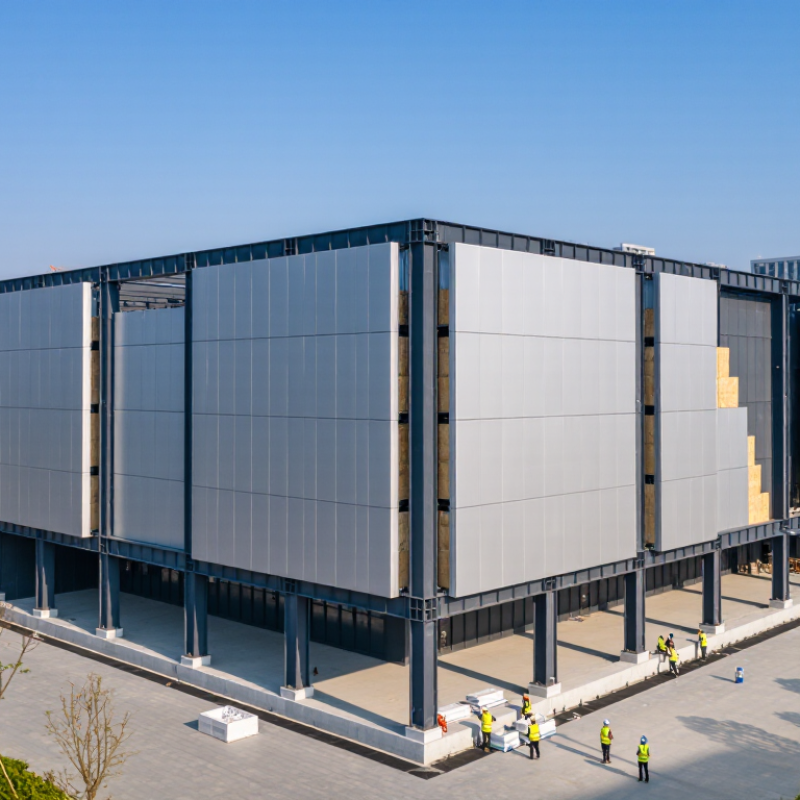
Insulated Metal Panels: Structure, Materials, and Core Functions
An insulated metal panel is a factory-made building component with a foam or mineral-fiber core between two metal facings. The outer skin often uses coated steel or aluminum, while the inner facing forms a clean, durable surface. Core choices vary: polyisocyanurate foam offers strong thermal resistance at relatively low thickness, while mineral wool can support specific fire-performance needs. No material suits every project.
Panel edges and joints matter. Interlocking profiles, gaskets, and sealants help limit air and water leakage, but poor installation can undermine a well-designed assembly. Details matter. Tight joints, correctly fastened supports, and careful flashing around openings all affect the finished envelope. Panels provide insulation and weather protection, and their factory-finished faces can reduce on-site cladding work. Some assemblies also meet tested fire or acoustic requirements; performance depends on the complete system, not the core alone. That distinction is easy to overlook. Designers should check documented thermal values, joint details, and tested assembly ratings for the intended building conditions. A panel can look simple on paper, yet small choices at corners and roof edges deserve a second look.
Insulated Metal Panel Core Materials: Typical Thermal Conductivity
Insulated metal panels typically combine metal facings with an insulating core. This chart compares representative thermal conductivity values for common core materials; lower values indicate better insulation per unit thickness.
Indicative values only: approximately 0.022 W/m·K for PIR, 0.024 for PUR, 0.036 for EPS, and 0.040 for mineral wool. Actual values vary by product, density, temperature, and test method.
China’s Insulated Metal Panel Manufacturing Landscape
China Top Insulated Metal Panel Manufacturers?
China’s Insulated Metal Panel Manufacturing Landscape
China’s insulated metal panel sector includes large production lines and smaller specialist factories. Manufacturers commonly work with steel facings and cores such as PIR or mineral wool. Product performance depends on more than insulation thickness. Joint design, coating durability, and installation details also matter. Some suppliers focus on cold storage, while others serve industrial roofs and wall systems. The market is not perfectly uniform. Factory capacity and quality controls can differ, even when product data looks similar.
Tips: Ask for recent test reports and clear panel specifications. Check core type, steel thickness, coating, and joint profiles. Request a sample, then inspect its edges and finish. Small details count.
For a reliable comparison, look beyond catalogue claims. Ask how production batches are checked and how dimensional tolerances are recorded. A site visit can reveal storage conditions, cutting equipment, and packaging practices. If visiting is not practical, request dated production photos and traceable documentation. Confirm that test results match the proposed panel configuration, not just a similar model. I would also ask about replacement panels and delivery protection; these details are easy to overlook. A polished brochure is useful, but it cannot show every weakness.
Key Factors for Evaluating Leading Manufacturers
When comparing insulated metal panel manufacturers, examine verified performance rather than brochure claims. The 2023 Global Status Report for Buildings and Construction reported that buildings and construction accounted for 34% of global energy demand and 37% of energy- and process-related emissions in 2022. That makes thermal performance consequential. Ask for tested U-factors or R-values, test methods, and panel-joint details; a strong core cannot compensate for leaky seams. Check whether reported values reflect the complete assembly or only the panel. The distinction matters.
Fire documentation deserves equal scrutiny. Review test reports against the project’s applicable requirements, and confirm what the test actually covers. For example, a surface-burning result alone does not describe every aspect of a wall assembly’s fire performance. Ask about production quality checks, thickness tolerances, coating durability, and traceability. Then request references for projects in similar climates. Short answers are useful. Vague ones are not.
A capable supplier should also provide installation guidance, replacement-part availability, and clear warranty terms. Compare environmental product declarations when available, noting their boundaries before comparing embodied-carbon figures. No scorecard is perfect: local installation skill can change real-world results, and published thermal values may not capture every junction. I would ask to inspect sample joints and review project-specific submittals before approving a specification.
Manufacturer Profiles, Product Ranges, and Specialties
China’s insulated metal panel manufacturers generally fall into two profiles: broad-line producers and application-focused specialists. Broad-line factories may offer roof and wall panels with polyurethane, polyisocyanurate, or mineral-wool cores. Their catalogs often include several thicknesses, steel facings, and joint designs. Details matter.
Specialists may concentrate on cold rooms, food-processing facilities, or cleanrooms. Cold-storage panels often feature tightly fitted joints and thicker insulation to limit heat transfer. Cleanroom ranges may emphasize smooth, easy-to-clean surfaces. Mineral-wool panels are commonly selected where fire performance and acoustic control are important. Product suitability still depends on the project and verified test data.
When comparing suppliers, request technical sheets, core-density details, coating specifications, and current test reports. Ask how panels are packed and protected during transport; dented edges can complicate installation. A factory visit or sample review can reveal finish quality and joint consistency. Online catalogs are useful, but they rarely show every limitation. One detail is easy to miss: advertised dimensions may differ from usable coverage after panel joints are connected. It is worth checking before ordering.
Standards, Applications, and Supplier Selection Criteria
Insulated metal panels are not interchangeable, even when their thicknesses look similar. Match the specification to the building’s use and local requirements. Standards such as EN 14509 or relevant ASTM test methods may apply, but they assess different properties. Check whether reports cover the complete panel assembly, including joints and fixings. Fire performance deserves careful review; a surface-burning result alone does not establish the fire resistance of a whole wall. Thermal performance, air leakage, water penetration, and structural loads also matter. Details matter.
Cold-storage buildings need reliable thermal performance and tightly sealed joints to limit condensation and temperature swings. Food-processing facilities may require washable finishes and carefully sealed connections. Warehouses often place greater emphasis on spanning capacity and impact resistance. When evaluating suppliers, request current test reports, product data, installation instructions, and evidence of production quality checks. Ask how panel dimensions, core type, and metal thickness are verified between batches. Compare warranty terms, delivery schedules, and technical support—not just price. A sample joint or small mock-up can reveal gaps that a data sheet misses. No document shows everything. In practice, supplier comparisons can remain imperfect when tests use different conditions, so confirm that each result fits the intended project.
| Category | Dimension | Typical Data or Reference | Application and Evaluation Notes |
|---|---|---|---|
| Product standards | Chinese product standard | GB/T 23932-2009, Metal-faced sandwich panels for building applications. | Confirm the product type and test method are within the standard’s scope. Request test documentation for the exact panel construction being quoted. |
| Product standards | International reference | EN 14509:2013 covers self-supporting double-skin metal-faced insulating panels used in buildings. | Useful when a project specifies European requirements. Check the required edition, product scope, and conformity documentation for the destination market. |
| Fire performance | Reaction-to-fire classification in China | GB 8624-2012 specifies classification for the burning behavior of building materials and products, including classes such as A, B1, B2, and B3. | The classification belongs to the tested product configuration. Do not infer a panel’s rating from its core material alone; verify the report, specimen build-up, and project requirements. |
| Fire performance | Building fire-safety requirements | GB 55037-2022, the General Code for Fire Protection of Buildings, is a mandatory national engineering construction code in China. | The required fire performance depends on the building, occupancy, location, and design. Have the project designer confirm the applicable provisions and evidence needed. |
| Fire performance | Fire-resistance testing | The GB/T 9978 series provides test methods for fire resistance of building elements. | A reaction-to-fire classification and a fire-resistance rating describe different performance. Request the test evidence that matches the project’s specific requirement. |
| Fire performance | ASTM reference method | ASTM E84 measures surface-burning characteristics of building materials under specified test conditions. | This test is not, by itself, a fire-resistance rating. Confirm that the specified test method is accepted for the intended jurisdiction and use. |
| Core materials | Mineral wool | Indicative thermal conductivity: approximately 0.035–0.045 W/(m·K), depending on product density and test conditions. | Often considered where non-combustible insulation is a priority. Check the tested fire classification, water resistance, joint details, and structural performance of the complete panel. |
| Core materials | Polyisocyanurate (PIR) | Indicative thermal conductivity: approximately 0.021–0.026 W/(m·K), subject to product formulation and test method. | Can provide strong thermal resistance for a given thickness. Compare tested fire performance, smoke-related requirements, joints, and temperature limits rather than relying on core type alone. |
| Core materials | Expanded polystyrene (EPS) | Indicative thermal conductivity: approximately 0.034–0.040 W/(m·K), depending on grade and test conditions. | May be considered for projects where its insulation, cost, and applicable fire requirements are suitable. Verify the complete assembly’s classification and permitted use. |
| Applications | Cold storage and temperature-controlled facilities | Panel selection depends on target temperature, panel thickness, joint design, vapor control, and the required thermal performance. | Assess thermal bridges, air and vapor leakage, condensation risk, hygienic finish, and details around doors and penetrations. |
| Applications | Factories and warehouses | Roof and wall panels are selected according to span, support spacing, wind load, drainage, and the building’s fire-safety design. | Request load tables for the quoted profile and thickness. Confirm that the tables cover the project’s support conditions and design loads. |
| Applications | Cleanrooms and food-processing areas | Smooth, cleanable surfaces and well-sealed joints are commonly important; project-specific hygiene and environmental requirements apply. | Check coating suitability, surface finish, joint cleanliness, sealant compatibility, and whether the panel system can meet the required room classification. |
| Supplier selection | Traceable test reports | Reports should identify the tested product, materials, dimensions, test method, laboratory, and test date. | Check that the report applies to the quoted core, facings, thickness, joint, and intended use. Where required, verify laboratory accreditation and report authenticity. |
| Supplier selection | Technical consistency and quality control | Review documented specifications for core density, facing material and thickness, dimensions, coating, and tolerances. | Request production quality-control records and a representative sample. Compare the sample and final delivery with the approved specification. |
| Supplier selection | Structural and installation support | Relevant documents include span or load tables, installation details, fastening guidance, and joint and flashing details. | Confirm design assumptions, local wind and snow loads, support spacing, lifting and storage instructions, and responsibility for project-specific engineering. |
| Supplier selection | Commercial and delivery terms | Compare quoted scope, panel dimensions, accessories, packaging, delivery schedule, warranty terms, and after-sales support. | Request a like-for-like quotation and clarify exclusions, replacement-part availability, transport protection, and remedies for non-conforming goods. |
| Note: Thermal-conductivity figures are indicative ranges for insulation materials, not guaranteed panel values. Actual performance depends on the product, thickness, test method, joints, and installation. Confirm current standards and project-specific requirements with the relevant designer or authority. | |||