top of page

What Are the Top Types of Passive DAC Cables?

Passive Dac Cables are short-reach copper links for connecting switches, servers, and storage inside data centers. A Passive Dac Cable contains twinaxial copper conductors and uses host equipment to drive the signal, rather than built-in active electronics. That design can mean lower power use and less heat. It also limits practical reach. The cable is not a universal plug-and-play part.

The Ethernet Alliance’s 2024 Ethernet Roadmap tracks industry development across speeds including 400GbE and 800GbE. This matters because cable choice depends on both port speed and the equipment’s supported form factor. Common options include SFP+ DACs for 10GbE links, SFP28 DACs for 25GbE, QSFP28 DACs for 100GbE, and QSFP-DD or OSFP DACs for higher-capacity ports. Breakout versions connect one higher-speed port to several lower-speed ports. Check the switch manual. A matching connector alone does not guarantee compatibility.

For example, a short twinax cable may link two adjacent rack devices, while a breakout cable can connect a switch port to several servers. The Ethernet Alliance roadmap describes technology direction, not proof that every listed cable works with every device. Verify supported speeds, coding, length, and vendor compatibility before purchasing. A little caution helps. The naming can be confusing, and product listings sometimes omit details that matter. Compare the exact part numbers, then confirm the link in the equipment documentation.
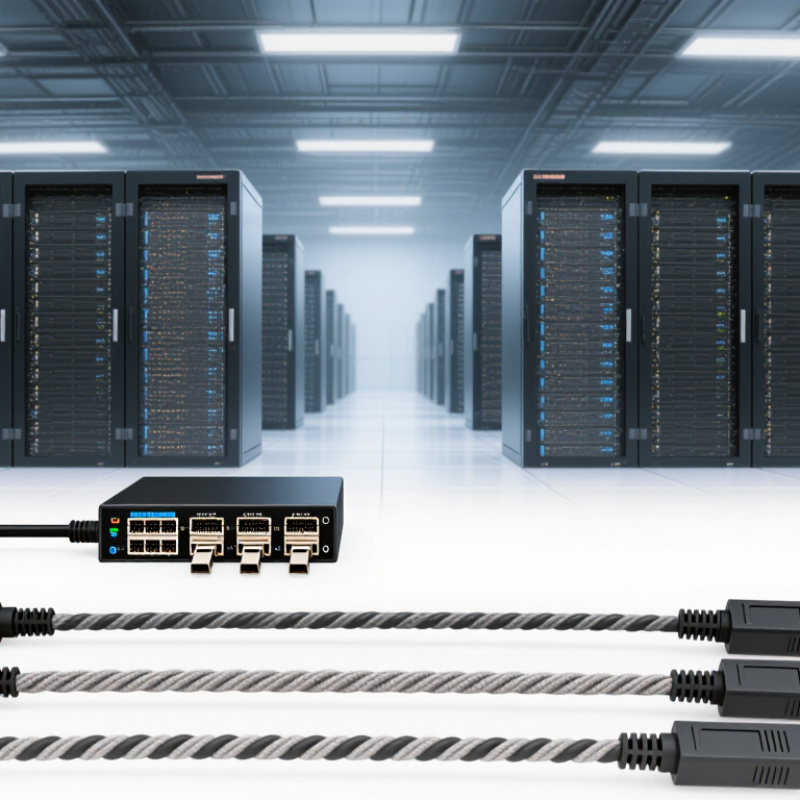
What Are the Top Types of Passive DAC Cables?

SFP+ Passive DAC: 10GBASE-CR Copper Links Reach Up to 7 m

SFP+ passive direct attach copper cables provide a short, low-power connection between compatible network ports. For 10GBASE-CR links, supported cable lengths can reach up to 7 meters. That range suits many rack connections, such as linking a switch to a nearby server. The cable contains no active signal-conditioning electronics, so it typically uses less power than an optical link. Less heat, too. Still, 7 meters is a maximum, not a guarantee for every setup. Check the cable’s stated reach and both devices’ compatibility before ordering.

Tips: Measure the actual cable route, including bends and slack. Leave room for airflow and access to neighboring ports. Confirm that each port supports the intended SFP+ passive copper connection. A cable that fits physically may not be accepted by every device.

Passive DACs are most practical when endpoints sit close together and a fixed-length cable can reach cleanly. They can simplify a rack, but they are less flexible than fiber if equipment moves or spans grow. One detail is easy to overlook: tight bends and crowded cable paths can make installation awkward. The neatest route is not always the shortest.

SFP28 Passive DAC: 25GBASE-CR Links Reach Up to 5 m

Among passive DAC options, SFP28 twinax cables connect 25GBASE-CR ports over short distances, with supported links reaching up to 5 m. The cable has copper conductors and SFP28 connectors at both ends. No optics are involved. That matters in a server rack, where a direct connection can reduce power use and avoid separate transceivers. Passive cables do not amplify or retime signals, so both devices must support the cable type and its intended speed.

A five-metre reach is a ceiling, not a planning target. For a switch and server in adjacent rack positions, a measured 1 m or 2 m cable can keep slack manageable and reduce clutter across the rear panel. Longer runs need closer attention to device compatibility, cable specifications, and routing. Tight bends or pressure from a closed rack door can strain the assembly. The awkward part is that “up to 5 m” does not guarantee every combination will work at that distance. Check each port’s documentation and allow room for cable routing. A little extra margin helps.

QSFP+ Passive DAC: 40GBASE-CR4 Links Reach Up to 7 m

QSFP+ passive DAC cables connect switches and servers through short copper links, without optical transceivers. IEEE 802.3ba specifies 40GBASE-CR4 operation over twinax copper for distances up to 7 m. The link carries four lanes, each signaling at about 10.3 Gb/s, for an aggregate rate near 40 Gb/s.

That matters.

At rack scale, a cable can run directly between adjacent ports, reducing extra components and power use. The 7 m figure is a ceiling, not a guarantee for every installation.

Cable length, host support, and routing still need checking. The QSFP+ interface is defined in the SFF-8436 specification, while IEEE 802.3ba describes the 40GBASE-CR4 physical layer. Together, these references help distinguish a standards-based link from a cable that merely fits the port. Keep the route short and avoid tight bends behind crowded racks; copper assemblies can be stiff.

But there’s a catch.

Actual link reliability depends on the complete channel and compatible equipment, so verify the host’s supported cable type before deployment. A few centimetres of slack can help, though too much cable makes airflow and servicing harder.

QSFP28 Passive DAC: 100GBASE-CR4 Links Reach Up to 5 m

QSFP28 passive DAC cables provide a compact way to connect 100GBASE-CR4 ports across short distances. A qualified copper assembly can reach up to 5 m. Inside the cable, four electrical lanes carry roughly 25 Gb/s each, combining for a 100G link. There is no optical conversion or active signal retiming, which helps keep power use and installation complexity low. The trade-off is reach: this is a short-run connection, not a substitute for fiber across a room or building.

In a rack, a 1–3 m cable may link a switch to a nearby server, while a 5 m run can help span adjacent racks. Actual results depend on cable qualification and the interoperability of both ports. Check supported cable types, port settings, and any host requirements before ordering. A tight bend behind a server can strain the cable or block access to neighboring connections. It is an easy detail to miss.

Tips: Measure the real cable path, including slack for service. Keep bends gentle, and label both ends. If a link fails, verify port compatibility and seating before replacing hardware.

QSFP-DD and OSFP Passive DAC: 400GBASE-CR4 Links Reach Up to 3 m

For short, high-density links, QSFP-DD and OSFP passive DAC cables offer a direct copper connection without optical transceivers. IEEE 802.3ck-2022 specifies 400GBASE-CR4 as four 100 Gb/s lanes, with passive copper reach up to 3 meters. That limit suits connections between adjacent racks or devices mounted in the same rack. Shorter is often safer.

QSFP-DD and OSFP describe module form factors, not a guarantee that every cable will work in every system. Their respective MSA specifications define mechanical and electrical requirements; buyers should also confirm host compatibility and supported cable lengths. A three-meter cable can be useful, but tighter bends, crowded cable trays, and connector strain may complicate installation. These details are easy to underestimate.

In practice, check the equipment’s compatibility list, lane rate, and cable gauge before ordering. IEEE’s 400GBASE-CR4 specification is the key reference for the link type; the QSFP-DD and OSFP MSA documents help verify connector requirements. Passive DACs avoid separate optics and fiber patching, but copper remains sensitive to channel conditions. The 3-meter figure is a ceiling, not a promise that every setup will achieve the same margin.

What Are the Top Types of Passive DAC Cables? - QSFP-DD and OSFP Passive DAC: 400GBASE-CR4 Links Reach Up to 3 m

Passive DAC type Connector form factor Lane configuration Aggregate data rate Common cable lengths* Typical applications
SFP+ DAC SFP+ 1 × 10 Gb/s 10 Gb/s About 0.5–7 m Short server-to-switch links and rack-level 10GbE connections.
SFP28 DAC SFP28 1 × 25 Gb/s 25 Gb/s About 0.5–5 m 25GbE server access and short-reach data-center connections.
QSFP+ DAC QSFP+ 4 × 10 Gb/s 40 Gb/s About 1–5 m 40GbE links between switches or network devices in the same rack.
QSFP28 DAC QSFP28 4 × 25 Gb/s 100 Gb/s About 1–5 m 100GbE top-of-rack links and short connections between switches.
QSFP56 DAC QSFP56 4 × 50 Gb/s 200 Gb/s Commonly around 1–3 m 200GbE rack-level links and short-reach interconnects.
QSFP-DD 400G DAC QSFP-DD 8 × 50 Gb/s or 4 × 100 Gb/s, depending on interface implementation Up to 400 Gb/s Commonly around 1–3 m; reach depends on cable and equipment qualification 400GbE switch and server connections within a rack or between adjacent racks.
OSFP 400G DAC OSFP 8 × 50 Gb/s or 4 × 100 Gb/s, depending on interface implementation Up to 400 Gb/s Commonly around 1–3 m; reach depends on cable and equipment qualification Short-reach 400GbE links in systems designed with OSFP ports.
Breakout DAC QSFP+ or QSFP28 to multiple SFP+/SFP28 ends 4 × 10 Gb/s or 4 × 25 Gb/s 40 Gb/s or 100 Gb/s aggregate Often about 1–5 m, depending on the cable assembly Connecting one higher-speed switch port to four lower-speed server or switch ports.

*Cable lengths are typical product ranges, not universal guarantees. Actual passive-DAC reach depends on cable construction, wire gauge, port implementation, and system qualification. A 3 m 400G passive DAC may be supported by specific equipment, but it should not be assumed to meet every 400GBASE-CR4 implementation; check the applicable standard and equipment specifications. Passive DACs use copper twinax cable and do not contain optical transceivers.

bottom of page