Where to Buy Top Used Communication Testers in China?
China’s electronics market offers several routes for finding pre-owned communication test equipment, from specialist instrument resellers to online industrial marketplaces and local trading companies. The right source depends on the model, budget, and support you need. A Used Communication Tester may handle wireless, radio-frequency, or network measurements, but its condition matters as much as its advertised specifications. Ask for the exact model and serial number, clear photos of the front and rear panels, and a list of included accessories. Cables, adapters, and software licenses can affect the instrument’s usefulness and total cost.
Request evidence of recent operation, such as a demonstration video showing the unit completing relevant measurements. Check whether the seller can provide calibration records, repair history, and a written return policy. Calibration status is not the same as a guarantee of performance, so confirm what testing was actually performed and when. If possible, arrange an independent inspection before payment. Compare quotes carefully, including shipping, packaging, and any after-sales support. A low price can hide missing options or worn connectors. Still, paperwork can be incomplete. That deserves a pause. This guide explains where buyers can look in China, how to assess sellers, and which practical checks help reduce avoidable risks. No checklist removes every doubt, but careful questions make the purchase more informed.
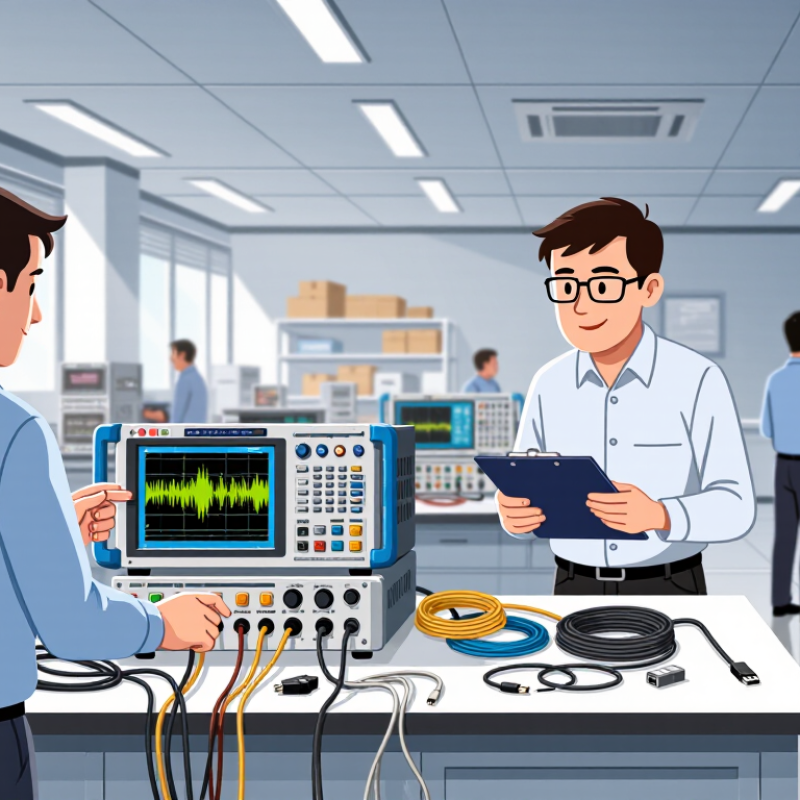
Communication Testers in China: RF, Optical, and Ethernet Equipment Types
China’s used communication-test market covers RF, optical, and Ethernet instruments. For RF work, spectrum analyzers, signal generators, and vector network analyzers help check emissions, receiver sensitivity, and antenna paths. Ericsson’s November 2024 Mobility Report forecast 2.3 billion 5G subscriptions by year-end 2024, increasing demand for reliable radio testing. Choose equipment with a frequency range and bandwidth that match your actual test plan. A bright display is not proof of accuracy.
Optical testers serve fiber installation and maintenance. OTDRs locate breaks and splice loss; power meters check received signal levels. Inspect launch cables, connector condition, calibration records, and wavelength settings before buying.
Ethernet testers measure throughput, latency, packet loss, and link negotiation across different port speeds. The ITU’s Facts and Figures 2024 estimated 5.5 billion people used the internet, or 68% of the global population, reinforcing the need for dependable network infrastructure. In China, compare specialist used-instrument dealers and refurbishment suppliers, and request a live demonstration with your cables or network setup. Ask for a recent calibration certificate, clear return terms, and a written list of included accessories. I would verify those details in person when possible; paperwork can be incomplete, and that matters.
Key Specifications: 5G NR (3GPP) and 400GbE (IEEE 802.3bs)
Where to Buy Top Used Communication Testers in China?
When sourcing a used tester in China, match its installed options to the standards you need—not just the model label. For 5G NR, check 3GPP release support, frequency bands, channel bandwidth, modulation analysis, and MIMO test capacity. GSMA’s Mobile Economy 2024 report projects 5.5 billion 5G connections worldwide by 2030, increasing demand for reliable field and lab verification. Ask the seller for a recent calibration record, option list, and live demonstration using a known-good signal. Small details matter. A missing software license can block a planned test.
For 400GbE, confirm support for IEEE 802.3bs physical-layer testing and the exact optical interface. FR8 and LR8 configurations use eight 50 Gb/s PAM4 lanes, so check lane-level diagnostics, error counters, and optical power measurements. Request a test report showing the unit’s condition under sustained traffic, not only a startup screen. Compare that report with the calibration date and serial-number records. A seller who permits independent inspection offers stronger evidence than polished photos. Still, older instruments may have limited firmware or aging connectors; I would treat those as real costs, not minor discounts.
Where to Buy Top Used Communication Testers in China?
When evaluating a used tester, check that its installed options and software support the standards and frequency ranges you need—not just the instrument’s headline specifications.
5G NR Subcarrier Spacing by Numerology
For normal cyclic prefix, 3GPP NR numerologies μ = 0–4 correspond to subcarrier spacings of 15, 30, 60, 120, and 240 kHz; their slot durations are 1, 0.5, 0.25, 0.125, and 0.0625 ms, respectively. The applicable numerology depends on the NR channel and use case.
For 400GbE, verify support for IEEE 802.3bs physical-layer testing and the relevant interface type. Confirm the used tester’s supported rates, test modules, software licenses, and calibration status before purchase.
Used-Tester Inspection: Calibration Records and ISO/IEC 17025 Labs
When buying a used communication tester in China, ask the seller for the latest calibration certificate before discussing price. Check that its serial number matches the instrument, and confirm the calibration date, due date, measurement uncertainty, and as-found results. A sticker is not enough. The lab’s accredited scope should cover the measurements you need, such as RF power, frequency, or modulation quality. A lab may hold ISO/IEC 17025 accreditation but lack scope for a specific test.
Verify the lab’s accreditation status and scope through its accreditation body or the ILAC MRA directory. The directory lists 116 accreditation-body signatories across 108 economies, according to its 2024 figures. That network helps buyers check whether a certificate comes from a recognized accreditation system; it does not guarantee the instrument is suitable or fault-free.
Ask for a short demonstration using a known signal source. Watch for unstable readings, loose RF connectors, and slow booting. Request the original calibration report, not a seller-created summary.
If the records are incomplete, budget for recalibration by an appropriately accredited lab before relying on the tester. I would still inspect the unit in person when possible; paperwork can look perfect while a worn connector quietly skews results.
Where to Buy in China: Authorized Dealers, Refurbishers, and Marketplaces
China offers three practical places to look for used communication testers: authorized dealers, specialist refurbishers, and online marketplaces. Authorized dealers may provide clearer sourcing records and service options, though their used inventory can be limited. Ask for written confirmation of the unit’s condition, included accessories, and any remaining support. That matters.
Refurbishers can be useful when they provide a dated inspection report, calibration status, and photos of the actual tester. Check that the screen, connectors, buttons, and battery work, and request a sample measurement or self-test result. Calibration paperwork is helpful, but it does not guarantee suitability for every task. Match the instrument’s frequency range and functions to your requirements.
Marketplaces often show more listings and price variation, but sellers’ descriptions may be incomplete. Request the serial number and a clear photo of the rear label before paying. Confirm return terms, warranty duration, and who handles shipping if a fault appears. Not every listing qualifies. A clean case can conceal worn connectors or missing options, so visual condition alone is a weak measure. Comparing several sellers takes time, and sometimes the lowest quote is simply not the best value.
Purchase Checks: Serial Numbers, Warranty, Service, and Export Terms
When buying a used communication tester in China, match the chassis serial number with the startup screen, calibration certificate, and sales invoice. Ask for clear photos before payment. A mismatch is a reason to pause, not a paperwork detail. Request a recent calibration report showing measurement results, uncertainty, date, and the laboratory’s scope. ISO/IEC 17025 accreditation can support confidence, but verify that the relevant measurement is covered.
Get the warranty in writing. It should state its duration, covered faults, repair location, and who pays return freight. Ask whether service includes firmware support, replacement parts, and a written repair estimate. ITU and UNITAR’s Global E-waste Monitor 2024 reports that the world generated 62 million tonnes of e-waste in 2022, while only 22.3% was documented as formally collected and recycled. That figure is not tester-specific, but it makes repairability and end-of-life handling worth checking.
Be precise about export terms. Confirm the named delivery point, packing method, insurance responsibility, included cables, and who prepares shipping documents. Check the destination’s import requirements with a qualified customs professional. A short video showing the unit generating a signal and completing a basic measurement is useful, though it cannot replace inspection. I would still hesitate if the seller refuses a serial-number check. Some uncertainty remains.